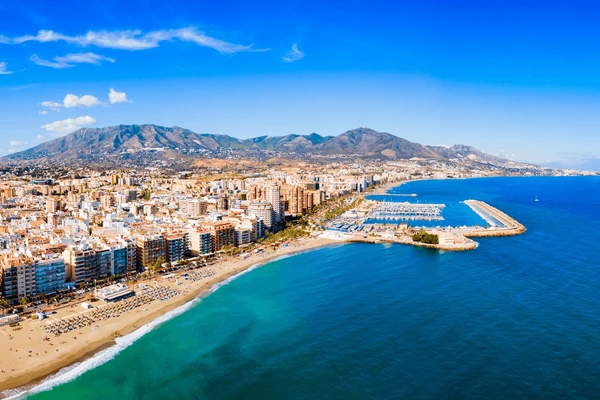
The property market across the Costa del Sol is entering a new phase—one increasingly shaped by American capital seeking stability, lifestyle, and long-term value.
In 2026, U.S. buyers are no longer a marginal presence. They are emerging as one of the fastest-growing and most influential buyer groups, particularly in prime locations such as Marbella, Estepona, and Benahavís.
The ‘Safe Haven’ Shift
Historically, American buyers have focused on domestic markets or traditional European cities such as London and Paris. That pattern is now shifting.
The Costa del Sol is increasingly being repositioned as a “safe haven” destination, offering:
- Political and economic stability within the EU
- Strong legal protections for property ownership
- A mature, transparent real estate framework
- High-quality lifestyle infrastructure
For U.S. buyers navigating global uncertainty, Spain—and specifically the Costa del Sol—offers a balanced combination of security and long-term upside potential.
Why Americans Are Moving Capital to Spain
Several macro factors are accelerating this shift:
1. Dollar Strength
The relative strength of the U.S. dollar against the euro continues to enhance purchasing power, allowing American buyers to access premium assets at a relative discount.
2. Portfolio Diversification
High-net-worth individuals are increasingly diversifying outside the U.S., allocating capital into:
- European real estate
- Lifestyle assets
- Income-generating properties
The Costa del Sol sits at the intersection of all three.
3. Lifestyle Relocation
This is no longer purely investment-driven. Buyers are:
- Relocating part-time or full-time
- Seeking quality of life improvements
- Prioritising climate, safety, and connectivity
The result is longer holding periods and stronger price support.
Prime Market Impact
The influence of American buyers is most visible in the upper tiers of the market.
Across Marbella and surrounding areas:
- Demand for €2M–€10M+ properties is increasing
- Turnkey, design-led villas are absorbing quickly
- Off-market transactions are becoming more common
U.S. buyers are also demonstrating a consistent willingness to:
- Move quickly
- Pay premiums for quality
- Prioritise location and finish over price negotiation
This behaviour is resetting expectations in the prime segment.
A Market Rebalancing Around Trust
As American participation increases, the market is adapting.
Unlike traditional European buyers, U.S. purchasers:
- Often transact remotely
- Expect institutional-level transparency
- Require clear, verifiable data
This is driving a structural shift:
- Verified, well-documented properties → higher conversion rates
- Unverified or inconsistent listings → reduced buyer confidence
In a “safe haven” market, trust is not optional—it is foundational.
Supply Constraints Reinforce the Trend
While demand from American buyers rises, supply remains limited:
- Scarcity of prime land in key municipalities
- Planning restrictions
- Slower development pipelines
This imbalance is particularly acute in Marbella and Benahavís, where top-tier inventory is increasingly constrained.
The result is a reinforcing cycle:
International capital inflow → limited supply → price resilience → sustained demand
NLS Market Perspective
From an NLS standpoint, the emergence of the Costa del Sol as a safe haven market signals a deeper structural transformation:
The buyer profile is becoming more global, more sophisticated, and more data-driven.
American buyers are accelerating:
- The demand for verified listings
- The importance of accurate pricing
- The need for structured, transparent property data
This is not simply increasing prices—it is raising the operational standard of the market.
The NLS Conclusion
The Costa del Sol is no longer simply a lifestyle destination.
It is evolving into a capital preservation and allocation market for international buyers.
For American investors:
- Stability is the entry point
- Lifestyle is the justification
- Long-term value is the objective
But in this environment, access to demand is not automatic.
The market is converging around a single defining principle:
Only trusted assets behave like safe havens.
And in 2026,
trust is built through verification, not visibility.