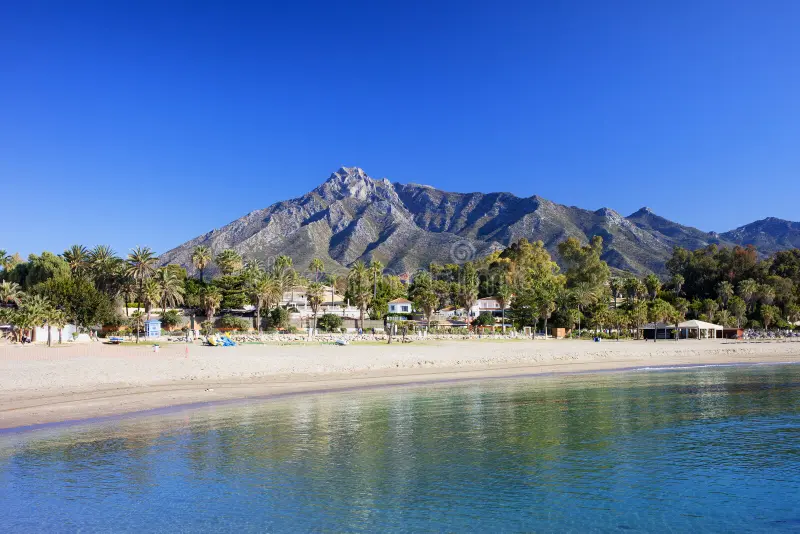
Historically, international property investment on the Costa del Sol was concentrated in Marbella.
When Marbella experienced growth, surrounding municipalities benefited indirectly.
Today the dynamic has changed.
Rather than one dominant market, the Costa del Sol increasingly operates as a connected investment corridor stretching from Málaga Airport to Gibraltar.
Infrastructure improvements, remote working, population growth and international migration have created a situation where buyers are increasingly willing to consider a broader geographic area.
This has significant implications for pricing.
As values rise in one municipality, demand spills into neighbouring markets.
This pattern has already transformed Estepona.
Increasingly, it is beginning to transform Manilva and even parts of Campo de Gibraltar.
Marbella: The Region’s Wealth Magnet
Marbella remains the market leader.
However, its role has evolved.
Rather than simply being a municipality, Marbella now functions as the economic and branding engine of the entire western Costa del Sol.
The town attracts:
- Ultra-high-net-worth individuals
- International entrepreneurs
- Family offices
- Digital business owners
- Luxury second-home buyers
Many arrive with budgets exceeding €1 million.
Others exceed €5 million.
Some exceed €20 million.
As Marbella becomes more expensive, many buyers naturally begin exploring neighbouring municipalities.
This creates a ripple effect across the region.
Marbella East Is Becoming a Market of Its Own
An additional trend worth noting is the emergence of Marbella East as a distinct investment destination.
Areas such as:
- Los Monteros
- El Rosario
- Elviria
- Marbesa
- Cabopino
- Las Chapas
have evolved significantly over the past decade.
Many international investors increasingly prefer these locations because they offer:
- Larger plots
- Better value
- Lower density
- Strong rental demand
- Beach proximity
Developments such as Metrovacesa’s Medblue project demonstrate the confidence developers have in Marbella East’s future.
For some analysts, Marbella East may become one of the strongest-performing luxury submarkets on the Costa del Sol during the next decade.
Mijas: The New Middle Market Growth Engine
Mijas occupies perhaps the most interesting position in the current cycle.
It combines three characteristics rarely found together:
- International demand.
- Development capacity.
- Relative affordability.
Historically, Mijas was often overshadowed by both Marbella and Fuengirola.
Today it is increasingly viewed as a destination in its own right.
The municipality benefits from several growth drivers:
Population Expansion
The Costa del Sol’s population continues to grow.
Many newcomers are settling in Mijas because housing remains more accessible than Marbella.
New Developments
Projects such as Cordia’s planned 500-home scheme highlight growing developer confidence.
Lifestyle Migration
Remote workers continue choosing Mijas because they can achieve significantly better quality of life than in many northern European cities.
Estepona: The Greatest Transformation Story on the Costa del Sol
If Marbella is the established leader and Mijas is the growth market, Estepona is the transformation story.
Few municipalities in Spain have changed as dramatically over the past fifteen years.
The town has successfully reinvented itself through:
- Urban regeneration
- Public investment
- Infrastructure improvements
- Strategic planning
The result is a municipality increasingly capable of competing directly with Marbella for certain buyer profiles.
Many international purchasers now begin their search in Marbella and ultimately purchase in Estepona.
This would have been far less common a decade ago.
The Emerging Manilva Opportunity
Investors increasingly ask the same question:
“If Marbella was the story of the 2000s and Estepona was the story of the 2010s, could Manilva become the story of the late 2020s?”
There are reasons to believe it might.
Pricing Advantage
Manilva remains substantially cheaper than:
- Marbella
- Benahavís
- Estepona
Yet buyers still enjoy:
- Beaches
- Marina access
- Golf
- International community
- Gibraltar connectivity
Development Capacity
Unlike Marbella, significant development opportunities remain.
This gives developers flexibility.
Sotogrande Spillover
Perhaps most importantly, Manilva increasingly benefits from proximity to Sotogrande.
As luxury prices continue rising in Sotogrande, some demand naturally spills westward.
This trend appears likely to continue.
Why Punta Chullera Could Become One of the Costa’s Most Interesting Locations
Within Manilva, Punta Chullera deserves special attention.
Situated between La Duquesa and Sotogrande, it offers:
- Elevated sea views
- Large plots
- Relative scarcity
- Strategic positioning
Many industry professionals quietly believe Punta Chullera could become one of the strongest-performing micro-markets on the western Costa del Sol over the next decade.
The area remains significantly underappreciated compared with neighbouring luxury markets.
La Línea: The Gibraltar Trade
Perhaps the most overlooked investment story in southern Spain is unfolding in La Línea.
For decades, the municipality suffered from image problems.
Today, however, investors increasingly see opportunity.
Gibraltar’s Economy Continues Growing
The Rock remains home to:
- Financial services
- Online gaming
- Technology companies
- Insurance businesses
- Maritime services
Thousands of workers cross the border daily.
Housing Economics Favour Spain
Property within Gibraltar remains extremely expensive.
As a result, many professionals choose to live in Spain.
La Línea is often the logical choice.
Future Treaty Potential
Any future agreement governing Gibraltar’s relationship with the EU could further enhance cross-border integration.
Many investors view this as a significant long-term catalyst.
The Five-Tier Costa del Sol Investment Hierarchy
The market is increasingly stratifying into five distinct tiers:
| Market | Primary Theme |
|---|---|
| Marbella | Wealth preservation |
| Estepona | Lifestyle transformation |
| Mijas | Growth and expansion |
| Manilva | Emerging value play |
| La Línea | Gibraltar opportunity |
Each appeals to different investor objectives.
What Institutional Investors Are Seeing
The most important signal often comes from developers themselves.
Major players continue investing heavily because they see:
- Strong migration trends
- Foreign buyer growth
- Housing shortages
- Infrastructure investment
- Wealth migration
These are long-term themes.
Developers typically think in 5–10 year cycles.
Their continued commitment suggests confidence in the region’s future.
Expanded NLS Conclusion
The Costa del Sol investment story of 2026 is becoming increasingly sophisticated.
Marbella remains the luxury capital.
Mijas remains one of the strongest growth markets.
Estepona continues its remarkable transformation.
But the next phase of growth may increasingly be found further west.
Manilva is beginning to attract the attention that Estepona received fifteen years ago.
La Línea is emerging as a unique Gibraltar-driven opportunity that few international investors fully understand.
For NLS members, this is perhaps the most important takeaway.
The Costa del Sol growth story no longer ends in Marbella.
Nor does it end in Estepona.
Increasingly, it stretches from Málaga Airport to Gibraltar, creating a continuous corridor of investment, migration and development.
The agents, developers and investors who recognise this shift early may be best positioned to benefit from the next decade of growth.
Because while Marbella remains the headline, the broader western Costa del Sol may ultimately become the bigger story.