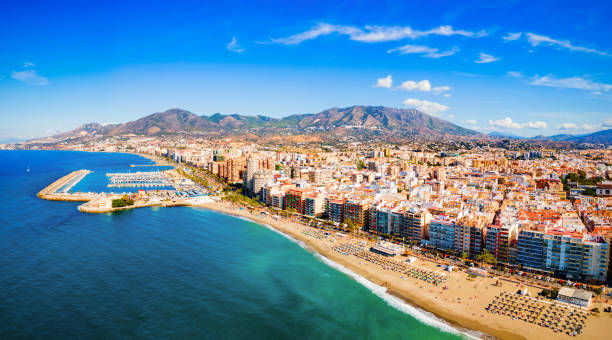
The Costa del Sol has evolved beyond its historical identity as a seasonal holiday destination into one of Europe’s most complete and resilient lifestyle-driven residential property markets.
This transition is not theoretical — it is supported by transaction data, infrastructure expansion, and increasingly diversified international demand.
According to the Instituto Nacional de Estadística (INE), Málaga province recorded over 34,000 property transactions in 2025, placing it among the most active real estate markets in Spain.
Crucially, foreign buyers accounted for approximately 32–35% of total transactions, one of the highest ratios nationally.
International Demand Concentrated in Prime Markets
In prime municipalities such as Marbella, this international influence becomes even more pronounced.
In new-build developments and luxury segments, foreign demand frequently exceeds 80% of total buyers, reinforcing the region’s position as a globally traded property market.
This level of international concentration is not typical of secondary markets — it is characteristic of globally relevant residential hubs.
Infrastructure Driving Structural Demand
Infrastructure plays a central role in sustaining this demand.
AENA, which operates Málaga Airport, handled over 22 million passengers in 2025, with direct connections to more than 130 destinations worldwide.
Long-haul connectivity — particularly to North America and the Middle East — continues to expand, directly supporting the rise in semi-permanent and permanent relocation trends.
Price Growth Confirms Market Strength
Price performance further validates the structural shift:
- +8–12% average price growth across the Costa del Sol (2025)
- +12–18% growth in Marbella’s prime areas (Tinsa)
- New-build properties commanding a 20–30% premium over resale stock
This premium reflects more than modern architecture — it highlights a clear buyer preference for turnkey, low-friction acquisitions.
A Fully Developed Residential Ecosystem
Beyond real estate, the Costa del Sol now offers a complete living infrastructure, positioning it as a primary destination rather than a secondary home market:
- 70+ international schools
- Advanced private healthcare networks
- A rapidly expanding technology and startup hub in Málaga
- Year-round lifestyle infrastructure including golf, gastronomy, and marina developments
This ecosystem is a key driver behind the region’s transition toward full-time residency demand.
The NLS Conclusion – Strategic Playbook
The Costa del Sol is no longer competing with Alicante, the Algarve, or the South of France.
It is competing with Dubai, Miami, and Lisbon — and increasingly winning.
1. Reposition the Product
Agents must move beyond marketing “holiday homes” and reposition properties as:
- Lifestyle relocation assets
- Wealth diversification tools
- Long-term residency solutions
This shift directly increases perceived value.
2. Understand Buyer Psychology by Nationality
The market is no longer homogeneous:
- Northern Europeans → stability and long-term value
- Americans → quality, speed, and design
- Middle Eastern buyers → privacy and prestige
Tailored messaging is now essential for conversion.
3. New-Build vs Resale Strategy
Developers are defining the price ceiling:
- New-build premium (20–30%) remains strong
Resale agents must:
- Compete on price per m², or
- Reposition assets through renovation, staging, or rebranding
4. Infrastructure as a Core Sales Tool
Infrastructure is no longer secondary — it is a primary driver of value.
Agents should actively leverage:
- Airport connectivity
- International schools
- Healthcare access
These are now decision-making factors, not supporting details.
5. Long-Term Market Direction
The Costa del Sol is structurally transitioning toward:
- Higher average prices
- Greater internationalisation
- Increased professionalisation
Final NLS Position
This is no longer a cyclical, tourism-driven market.
It is a globally relevant residential hub with sustained demand drivers.
Agents who elevate their positioning will capture disproportionate value.