The Registrars’ second-quarter figures were reported as a market cooling: sales at a seven-quarter low, transactions falling for a second consecutive quarter. Málaga province was one of sixteen that moved the other way — and it moved further than almost anywhere else.
SOURCE: COLEGIO DE REGISTRADORES, ESTADÍSTICA REGISTRAL INMOBILIARIA, 2T 2026 (PUBLICATION Nº 89, AUGUST 2026)
What the national headline said
On 5 August the Colegio de Registradores published its property statistics for the second quarter of 2026. The coverage that followed settled quickly on a single narrative: after three years of expansion, Spain’s housing market has begun to cool.
The figures supporting that reading are real. 167,934 home sales were registered between April and June, down 5.7% on the first quarter and 2.3% on the same period of 2025. It is the lowest quarterly total in seven quarters and the second consecutive fall. New-build took the heavier hit, dropping 11.5% to 34,919 transactions; resale fell 4% to 133,015. Fifteen of Spain’s seventeen autonomous communities registered quarterly declines, as did thirty-four of its fifty provinces.
Prices did the opposite. The repeat-sales index rose 3.14% in the quarter and 16.7% over twelve months, setting a seventh consecutive record and standing 39.31% above the pre-crisis peak of 2007. On the average-price measure, Spain reached €2,487 per square metre.
The Registrars themselves draw the obvious inference, and it is worth repeating because it frames everything that follows: demand is not indifferent to price. Eight consecutive quarters of double-digit price growth have begun to show up in transaction counts.
Eleven and a half years without a fall
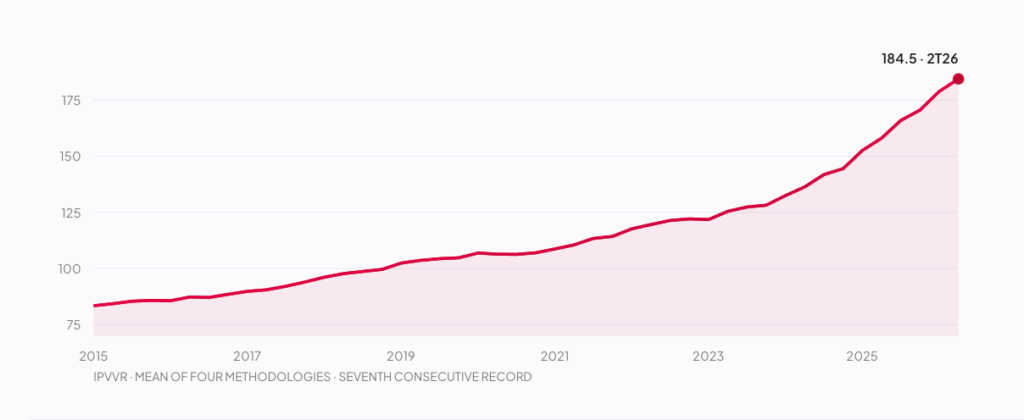
The repeat-sales index (IPVVR) has risen continuously since the end of 2014, more than doubling over the period. Its growth moderated slightly this quarter — from 3.9% to 3.14% — but remains high by any historical standard.
COLEGIO DE REGISTRADORES · IPVVR, MEAN OF FOUR METHODOLOGIES · 1T 2015 – 2T 2026
Málaga did not follow the pattern
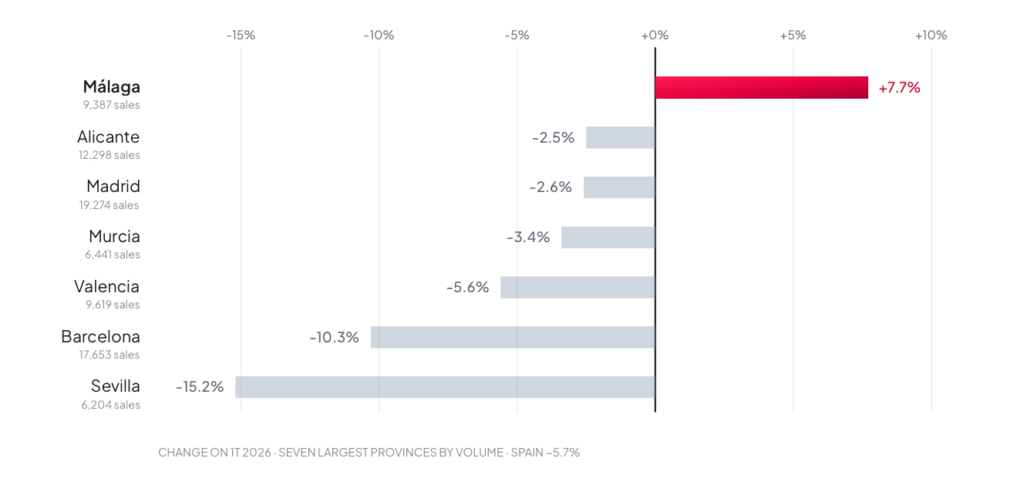
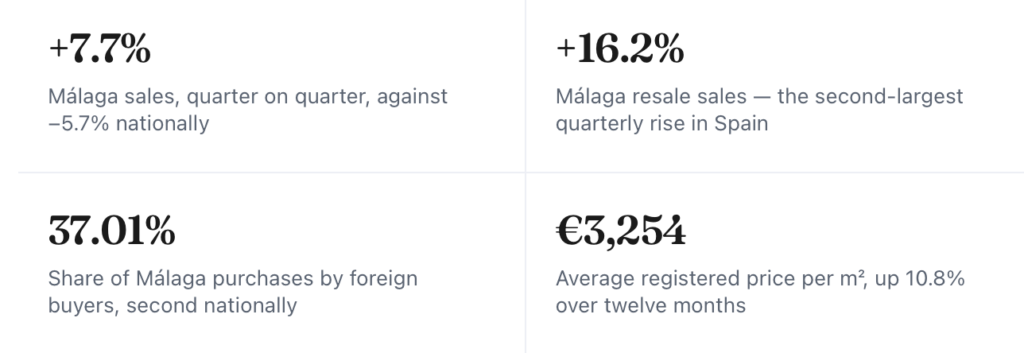
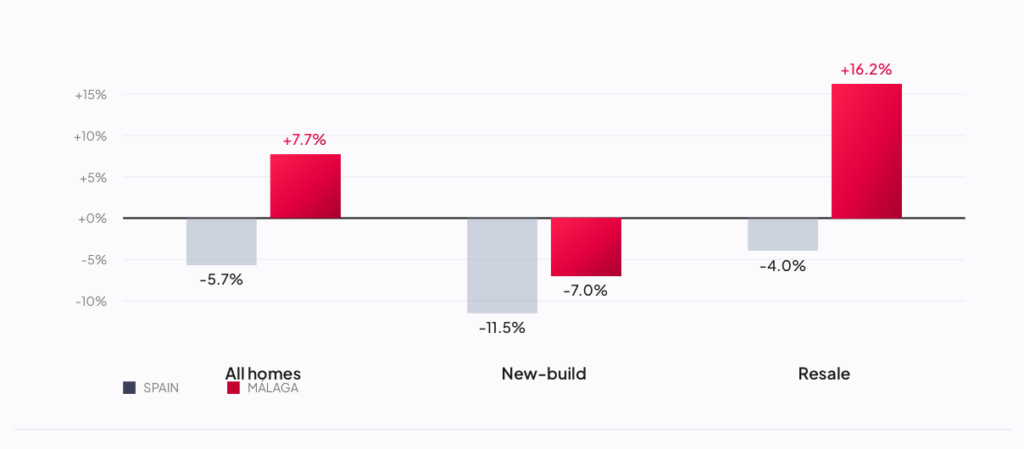
Beneath a national decline of 5.7%, Málaga province registered 9,387home sales — an increase of 7.7% on the first quarter. Of the seven largest provinces by volume, it was the only one to grow.
The composition matters more than the headline. Málaga’s new-build sales actually fell, by 7% to 2,967 transactions, broadly tracking the national new-build correction. The entire gain came from the resale market, which rose 16.2% to 6,420 sales. Across all fifty provinces, only Ourense recorded a larger quarterly increase in resale volume.
Nationally, resale fell 4%. In Málaga it rose 16.2%.
That divergence is the most interesting number in the report for anyone operating on this coast, and it deserves scepticism as well as attention. A swing of that size in a single quarter, in a single province, running counter to the national direction, invites the question of whether something structural changed in April, May and June — or whether the registry simply caught up on a backlog of contracts signed earlier.
The same quarter, read two ways
Málaga’s new-build market moved with the national trend. Its resale market moved sharply against it.
Set against the rolling twelve-month figures, the picture is more measured. Over the year to June, Málaga registered 35,839 sales, 2.3%fewer than the previous twelve months — fifth-highest in Spain by volume, but on a mildly negative trend. The honest framing is therefore a strong quarter inside a flat year, not a boom.
Málaga province, second quarter 2026
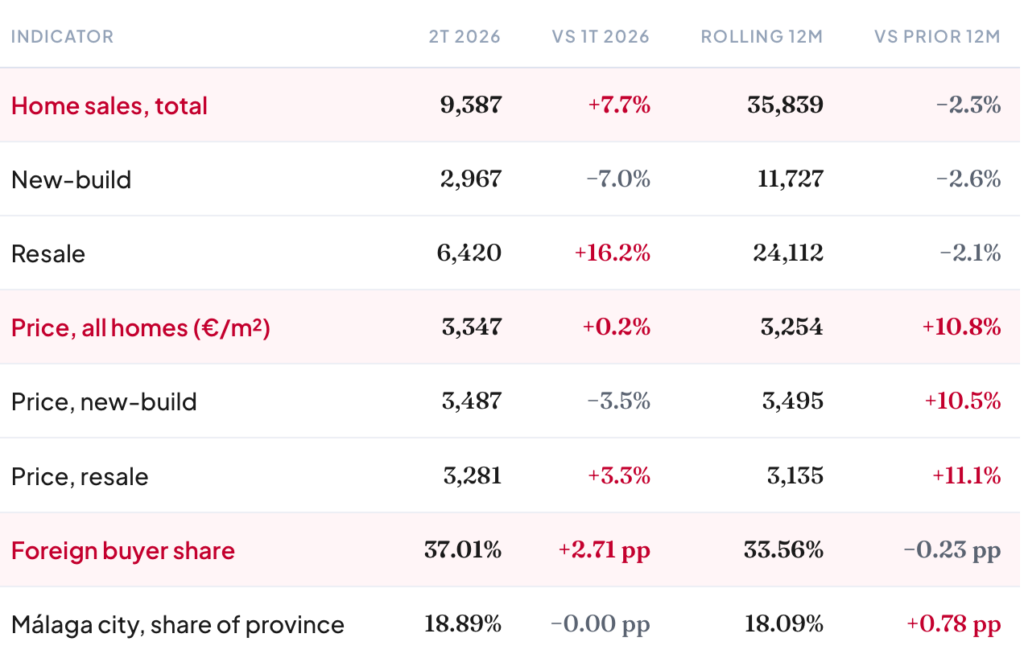
Málaga was third nationally for new-build volume in the quarter, behind Madrid (3,945) and Barcelona (3,543).
International demand set a national record — and Málaga sits near the top of it
Foreign buyers accounted for 15.98% of all Spanish home purchases in the second quarter, the highest share in the series and up from 13.92% three months earlier. In absolute terms that is a little over 26,800 purchases.
Málaga’s figure was 37.01%, a rise of 2.71 percentage points and second only to Alicante’s 46.43%. Every autonomous community increased its foreign share this quarter, and forty-six of fifty provinces did.
One number is worth isolating for anyone reading regional summaries. Andalucía as a whole records a foreign share of 15.95% — almost exactly the national average. Málaga is more than double that. The regional figure is not a proxy for this coast, and using it as one materially understates what is happening here.
Where international buyers actually buy
Share of registered home purchases made by foreign nationals, second quarter 2026. The leading provinces are Mediterranean and insular — the Registrars attribute the pattern to tourism intensity.
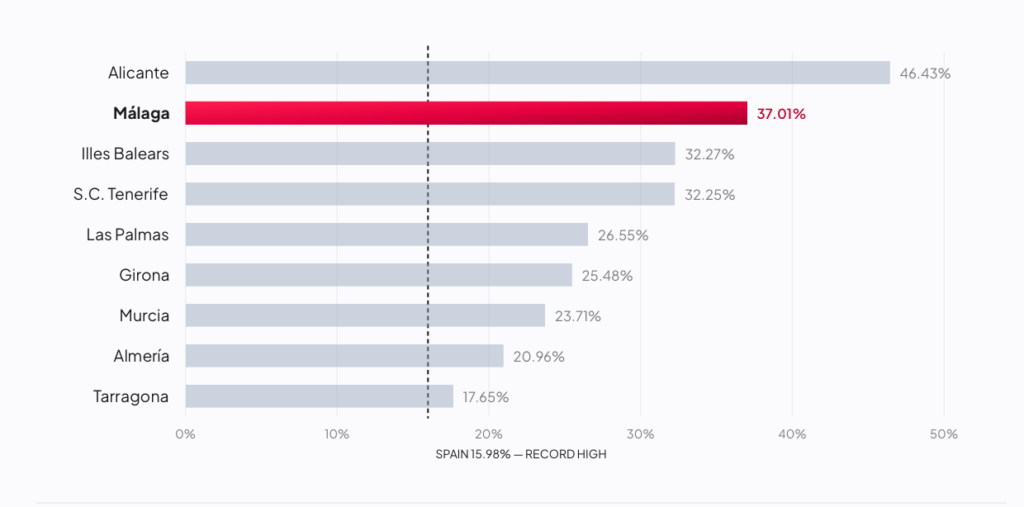
NINE HIGHEST PROVINCES · SPAIN 15.98%, AN ALL-TIME HIGH
The longer view is steadier than the quarterly jump suggests. On a rolling twelve-month basis Málaga sits at 33.56%, effectively where it has been since 2023. What changed this quarter was the national figure catching a little of the same lift, not Málaga breaking new ground.
Málaga’s international share has been flat and high for four years
Rolling twelve-month foreign buyer share. Alicante and Málaga have held a roughly constant lead over the national figure since 2022.
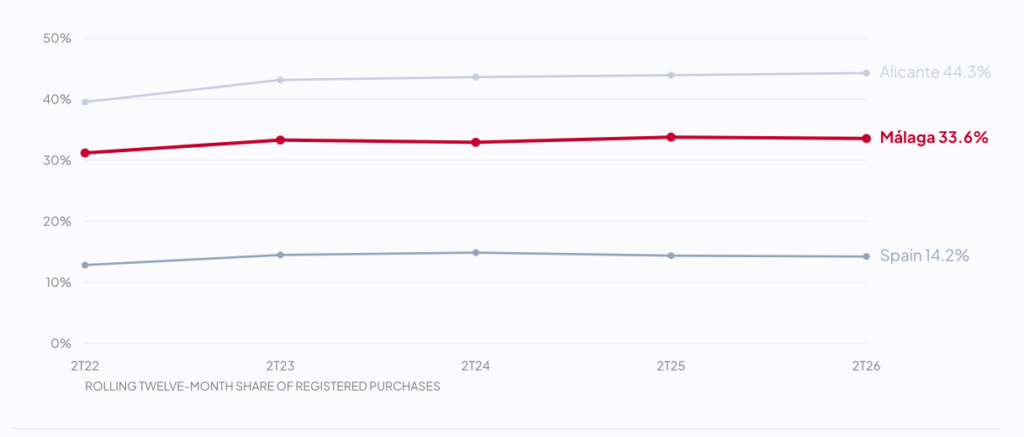
2T 2022 – 2T 2026 · SHARE OF REGISTERED PURCHASES
Which nationalities
Across Spain, the leading nationalities were British (6.99% of foreign purchases, 1,843 transactions), Dutch (6.94%), German (6.11%), Moroccan (6.09%) and Romanian (5.70%). By region of origin, EU nationals accounted for 57.39% of foreign purchases, the rest of Europe 16.75%.
The report also publishes average price paid by region of origin, which is the more useful cut for a prime market. North American buyers paid €4,311 per square metre — the highest of any group, and well above the EU average of €3,149. That is a small cohort nationally, at 2.87% of foreign purchases, but it is the cohort transacting at Costa del Sol price levels.
Fifth most expensive province in Spain
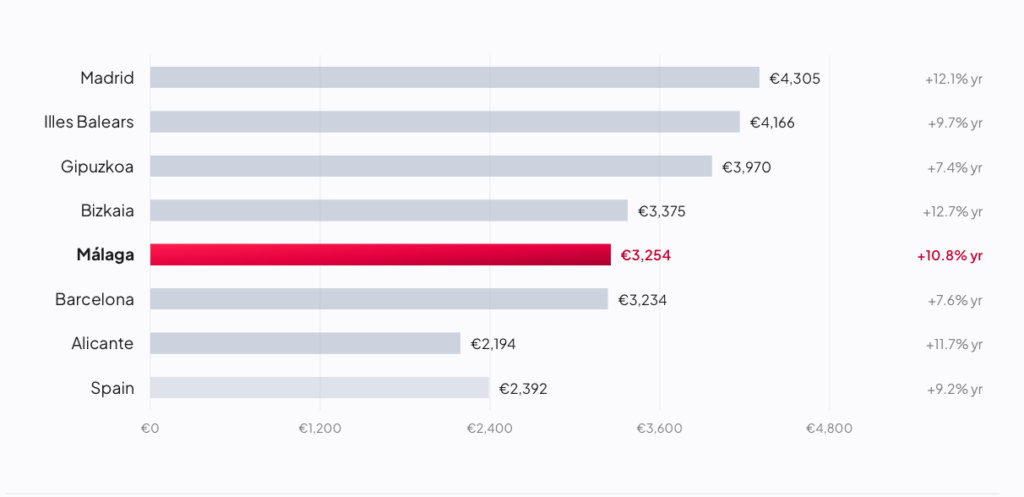
On the rolling twelve-month measure, Málaga’s average registered price reached €3,254 per square metre, up 10.8% — placing it fifth nationally, ahead of Barcelona.
Within the quarter itself the province recorded €3,347 per square metre, sixth highest. The split by type is instructive: resale prices rose 3.3% in the quarter while new-build prices fell 3.5%. Over twelve months both remain firmly positive, at +11.1% and +10.5% respectively.
Málaga city reached €3,401 per square metre on the twelve-month measure, up 14.7% year on year — sixth among Spanish provincial capitals, behind San Sebastián, Madrid, Barcelona, Palma and Bilbao.
Average registered price per square metre
Rolling twelve months to June 2026, by province. These are declared prices on registered transactions, not asking prices — they run materially below portal listings.
Financing tightened at the margin
Spain registered 129,240 mortgages on homes in the quarter, down 3.3% — a smaller fall than sales, so the share of purchases carrying a mortgage rose 1.9 points to 77%. Roughly a quarter of Spanish home purchases are still completed without borrowing.
Average borrowing per home reached €176,453, a record and the ninth consecutive quarterly rise. Contracted interest rates rose 0.04 points to 3.03%, a second consecutive increase and, in the Registrars’ reading, a change of direction. Fixed-rate lending fell to 63.83% of new mortgages.
The accessibility indicators deteriorated again. The average monthly payment reached €825, equal to 34.3% of average salary cost nationally. Andalucía sits at 35.3% — fourth worst of the seventeen communities, behind the Balearics, Madrid and the Canaries. Andalucía also recorded the highest number of foreclosure certifications in Spain, at 1,158, though the national total of 4,962 remains low by historical standards and daciones en pago fell to 306, a series minimum.
For a prime coastal market these figures are context rather than constraint — a market where more than a third of buyers are foreign and a large share transact without Spanish mortgage finance is only loosely governed by domestic affordability. But they are the numbers that will shape the domestic end of the Costa del Sol, and the political conversation around it.
Four things this data does not say
Registration lags the deal
The ERI counts inscriptions at the Land Registry, not signings. A private purchase contract — and in new-build especially, an off-plan reservation — can precede registration by months or years. A 16.2% quarterly jump in one province is large enough that timing effects should be considered before it is read as a demand surge occurring within the quarter.
Málaga province is not the Golden Triangle
The province runs from Nerja to Manilva and inland, and its average of €3,254 per square metre blends Marbella, Benahavís and Estepona with markets that price very differently. Provincial figures are the finest geography the ERI publishes. Anything at municipal or urbanisation level requires a different source.
Declared price is not market price
These are values declared on registered deeds. They sit below portal asking prices and below the figures quoted in most agency market reports, which draw on listings. The two are not interchangeable, and comparing one to the other produces misleading growth rates.
One quarter is not a trend
Málaga’s twelve-month sales total is down 2.3%. The strong quarter sits inside a flat year. The third-quarter release, due in November, is what will show whether the resale acceleration held.
The NLS Conclusion
Two things appear to be true at once, and the national coverage captured only the first.
Spanish transaction volumes are responding to three years of compounding price growth, exactly as the Registrars suggest. That is a genuine turn, and it is visible across most of the country.
At the same time, the markets driven by international rather than domestic demand are not turning with it. Alicante and Málaga hold foreign shares of 44% and 34% respectively on a twelve-month basis, against a national 14%. Buyers whose purchase decision is denominated in another currency, funded from another country, and motivated by lifestyle rather than housing need respond to a different set of inputs than the Spanish first-time buyer whose mortgage payment now absorbs a third of salary.
For sellers on this coast, that argues against importing a national cooling narrative into pricing decisions. For buyers, it argues against waiting for a correction that the provincial data gives no evidence of. And for both, the resale figure is the one to watch in November — because if a 16.2% quarterly rise in registered resale transactions turns out to be more than a registration artefact, it points to a market where the constraint has been supply of listings rather than depth of demand.
Source. Colegio de Registradores de la Propiedad, Bienes Muebles y Mercantiles de España, Estadística Registral Inmobiliaria, Segundo Trimestre 2026 (quarterly publication nº 89, August 2026), prepared by the Servicio de Estadísticas Registrales with technical support from the University of Zaragoza and the Grupo de Análisis del Mercado Inmobiliario. Published 5 August 2026. All figures in this article are drawn from that publication; the provincial and capital-level tables are not reproduced in the accompanying press note.
Method. Quarterly changes compare 2T 2026 with 1T 2026. Rolling twelve-month figures cover July 2025 to June 2026 and are compared with the preceding twelve months. Prices are values declared on registered deeds and are not comparable with portal asking prices. Foreign buyer share is measured by nationality of purchaser, not residence.
This article is market commentary and does not constitute investment, tax or legal advice.