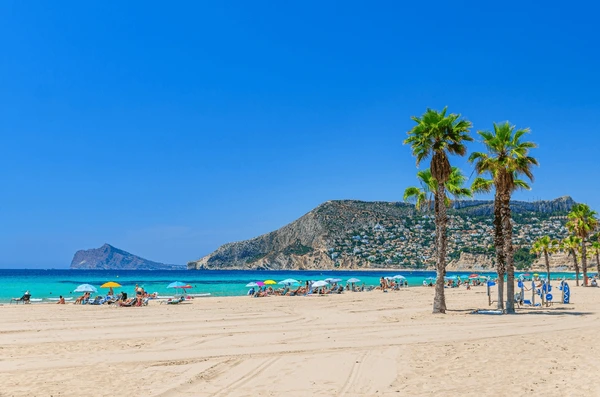
Costa Blanca continues to establish itself as one of Spain’s most stable, accessible, and commercially reliable residential property markets. While it does not generate the same headlines as the luxury-driven Costa del Sol or the supply-constrained Balearic Islands, its strength lies in consistency, depth of demand, and a diversified buyer base that supports steady long-term performance.
Located along the Alicante province coastline and anchored by cities such as Alicante, Jávea, and Torrevieja, the Costa Blanca offers a broad spectrum of property types and price points, making it one of the most liquid markets in the Spanish real estate landscape.
According to data from the Instituto Nacional de Estadística (INE) and the Spanish Land Registrars Association:
- Residential property prices in Alicante province increased by approximately 5–7% in 2025
- Foreign buyers accounted for around 45% of all transactions, one of the highest ratios in Spain
- Transaction volumes remained stable, reflecting consistent demand rather than speculative spikes
This combination of steady price growth and strong transaction activity highlights the Costa Blanca’s role as a performance-driven market, where reliability often outweighs volatility.
Market Structure: A Broad and Accessible Price Spectrum
One of the defining characteristics of the Costa Blanca is its wide pricing structure, which allows it to attract a diverse range of international buyers.
Typical segmentation includes:
- Entry-level apartments: €120,000 – €250,000
- Mid-market villas and townhouses: €250,000 – €600,000
- Prime coastal properties: €600,000 – €1.5M+
This range creates a layered demand profile that is less dependent on any single buyer group or economic condition.
In contrast to more premium markets, where pricing is driven by scarcity and luxury demand, Costa Blanca operates on volume, accessibility, and value positioning.
International Demand: The Core Market Driver
Foreign buyers are the backbone of the Costa Blanca property market. Unlike Marbella or Ibiza, where demand is concentrated at the high end, Costa Blanca attracts a broader mix of international clients.
Key buyer groups include:
- British buyers (historically dominant)
- Dutch and Belgian buyers
- Scandinavian purchasers
- German and French buyers
- Increasing interest from Eastern European markets
These buyers are typically motivated by:
- Affordability compared to other Mediterranean regions
- Climate and lifestyle benefits
- Retirement and second-home use
- Rental income potential
This diversity creates a resilient demand base, reducing exposure to shocks in any single national market.
Rental Market and Yield Performance
The Costa Blanca also benefits from a strong and active rental market, supported by both tourism and long-term residency trends.
According to Idealista:
- Average gross rental yields range between 4% and 7%, depending on location and property type
- Short-term holiday rentals perform strongly in coastal areas
- Long-term rentals are supported by a growing expatriate population
This dual rental structure provides flexibility for investors, allowing properties to be positioned for either:
- Income generation
- Hybrid personal use + rental return
Supply Dynamics: Balanced but Expanding
Unlike the Balearics or parts of Marbella, the Costa Blanca benefits from greater land availability and a more active development pipeline.
New-build activity continues across key areas, particularly in:
- Orihuela Costa
- Torrevieja surroundings
- Northern Costa Blanca zones like Jávea and Denia
This ongoing supply helps to:
- Moderate price inflation
- Maintain market liquidity
- Provide buyers with modern, turnkey options
However, it also introduces a key dynamic: competition between new-build and resale stock, particularly in the mid-market segment.
Market Behaviour: Stability Over Volatility
One of the most important characteristics of the Costa Blanca is its relative stability.
Compared to more speculative or supply-constrained markets, Costa Blanca tends to exhibit:
- Moderate but consistent price growth (4–6% forecast for 2026)
- Stable transaction volumes
- Lower volatility during economic downturns
This makes it particularly attractive for:
- Risk-conscious investors
- Retirees seeking long-term value
- Buyers prioritising affordability and lifestyle
🔎 The NLS Conclusion — Strategic Playbook
The Costa Blanca is not a prestige-driven market — it is a performance-driven ecosystem, and that distinction is critical for agents.
1. Volume and Consistency Are the Core Advantages
Unlike luxury hotspots, success in Costa Blanca is built on:
- Regular transaction flow
- Broad buyer demand
- Repeat business opportunities
Agents should prioritise pipeline management and lead conversion efficiency, rather than relying on large individual deals.
2. Pricing Strategy Must Reflect Competition
With ongoing new-build supply:
- Buyers have multiple comparable options
- Overpricing leads quickly to stagnation
Correct pricing from day one is essential, particularly in the €200K–€500K segment.
3. Product Knowledge Drives Conversion
Buyers in this market are often:
- Comparing multiple locations
- Evaluating rental potential
- Assessing long-term costs
Agents who provide clear, data-driven guidance will close faster and build trust.
4. Rental Positioning Is a Key Selling Tool
Yield remains a major attraction. Agents should actively communicate:
- Expected rental returns
- Seasonal demand patterns
- Licensing requirements
This transforms properties from lifestyle purchases into income-generating assets.
5. Ideal Market for Scalable Agency Models
Costa Blanca is particularly well-suited for:
- Franchise expansion
- Team-based sales structures
- High-volume lead generation systems
Its predictability makes it easier to standardise processes and scale operations.
6. Long-Term Outlook (2026–2030)
The Costa Blanca is expected to:
- Maintain steady price growth in the 4–6% range annually
- Continue attracting a diverse international buyer base
- Remain one of Spain’s most liquid and accessible markets
Final NLS Position
Costa Blanca may not dominate headlines, but it consistently delivers where it matters:
- Transactions
- Liquidity
- Scalability
It is not a speculative market.
It is not a scarcity market.
It is a working market — and for agents focused on building sustainable, repeatable business, it remains one of the most valuable regions in Spain.