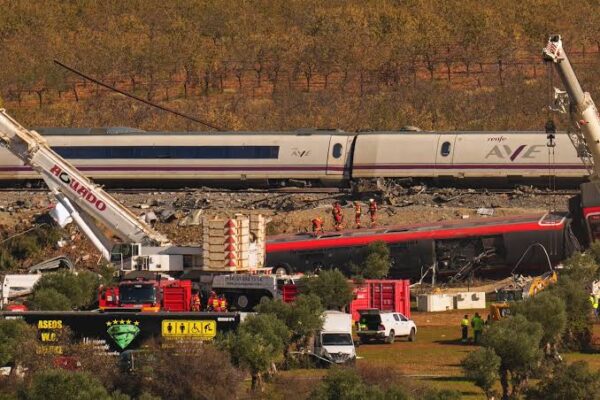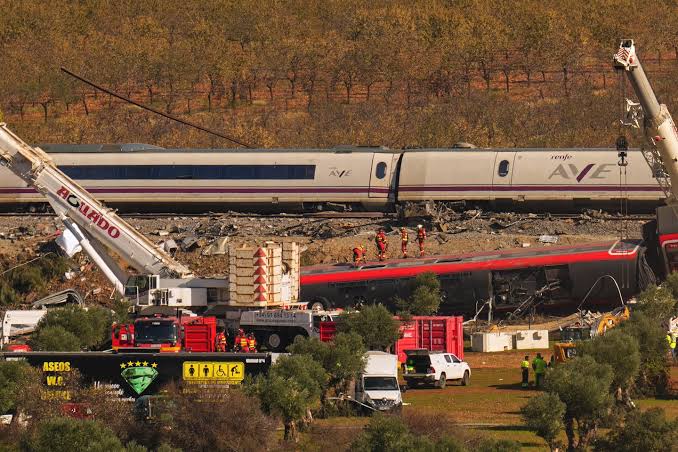
Investigators are examining signalling failures and safety procedures following a devastating collision near Toledo, raising fresh concerns about Spain’s high-speed railway network.
Spanish authorities have launched an investigation into a high-speed train collision near Toledo that claimed at least 69 lives on Wednesday, 28 October 2026, marking the country’s second major rail disaster this year.
The accident occurred on the Madrid–Seville high-speed line when a Renfe AVE train collided with the rear of a stationary Iryo service near Urda. Both trains had initially stopped following a signalling system failure, but the Renfe train was subsequently authorised to continue its journey.
The collision caused extensive damage to both trains, with several carriages derailing and emergency services responding to one of Spain’s deadliest railway accidents in recent history.
What Caused the Collision?
Initial findings indicate that a technical failure in the railway’s LZB signalling system disrupted operations, forcing several trains to stop.
According to recordings released to Spanish media, a controller in Madrid instructed the Renfe driver to resume travelling under normal operating conditions, despite the signalling disruption.
Transport Minister Óscar Puente described the instruction as inexplicable, although investigators have emphasised that it is too early to determine responsibility.
A preliminary report published on 30 October suggests that a combination of technical failures, operational decisions and safety procedures may have contributed to the disaster.
Questions Over Spain’s Rail Infrastructure
The tragedy has renewed concerns about the reliability of Spain’s extensive high-speed railway network.
Investigators are examining why existing safety mechanisms failed to prevent two trains from occupying the same section of track, alongside the circumstances surrounding the initial signalling malfunction.
The incident follows another fatal railway collision near Adamuz, Córdoba, in January 2026, which claimed 46 lives.
Railway unions have also raised concerns about infrastructure investment, staffing levels and maintenance, calling for improvements to ensure passenger safety.
Potential Impact on Transport and Connectivity
Spain’s high-speed rail network plays a vital role in connecting major cities, supporting tourism, business travel and regional economic development.
The Madrid–Seville corridor is particularly important for Andalucía, providing connections between the capital and southern Spain.
Following the accident, high-speed services along the affected route remain suspended, with no confirmed reopening date as of 30 October.
Reliable transport infrastructure is also an important factor in regional development and investment confidence, making the findings of the investigation significant beyond the railway sector.
Investigation Continues
Authorities are analysing communications between train drivers and control centres, technical data and operational procedures to establish the sequence of events leading to the collision.
The investigation will also assess whether wider infrastructure or organisational issues contributed to the accident.
As Spain mourns the victims, attention is turning towards ensuring that lessons from the tragedy lead to stronger safety measures across the country’s railway network.
Sources: The Guardian, 29 October 2026; SUR in English, 30 October 2026.